Wheel Balance Introduction
The weight of a wheel should be distributed evenly to create a balanced condition. If the
weight is distributed unevenly, centrifugal forces cause the wheel to vibrate as it turns.
Slight imbalance typically causes vibration of the steering wheel; More serious imbalance
causes vibration throughout the body. There are two types of wheel balance: static and
dynamic.
Static Wheel Balance
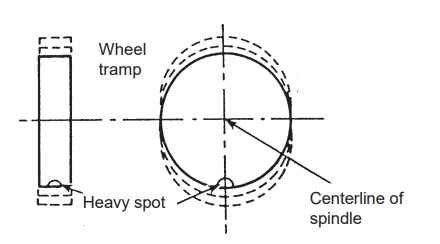
Static balance is the equal distribution of weight around the wheel. A statically balanced
wheel does not rotate by itself regardless of the position in which it is placed on its axis. By
contrast, a statically imbalanced (off axis) wheel tends to rotate by itself until the heaviest
portion reaches the bottom. During vehicle operation, static imbalance causes a bouncing
action that leads to uneven tire wear.
Dynamic Wheel Balance
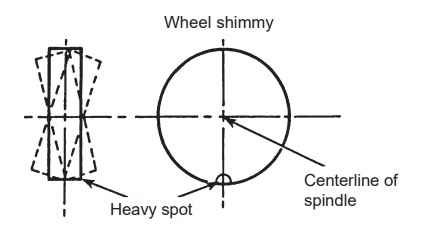
Dynamic balance is the equal distribution of weight on each side of the wheel’s center line
(as seen from the front or rear). During vehicle operation, a dynamically imbalanced (offcenter) wheel experiences side-to-side deflection, leading to vibration in the steering wheel
or body and to bald spots on the tire.
NOTE:
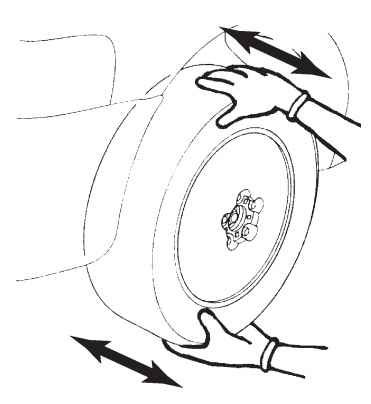
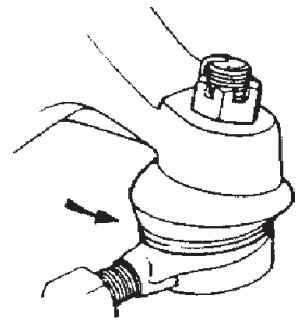
- Vibration and uneven tire wear can also be caused by factors other than imbalanced wheels (for example, by faulty ball joints or bearings in the suspension system).
- A small degree of wheel imbalance may have no noticeable effect at low speeds. However, it may cause increasingly severe vibration as the vehicle accelerates.
Wheel Balance Adjustment
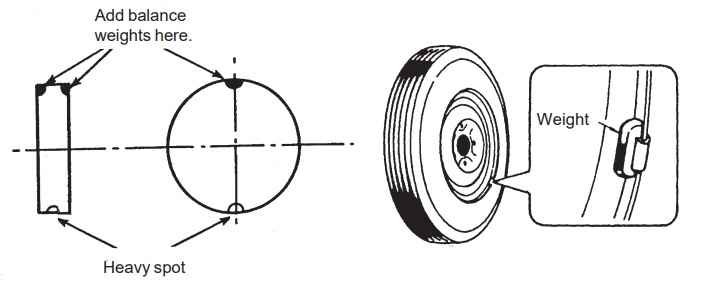
To correct static imbalance, a weight is attached to the wheel directly opposite the heavy
spot.
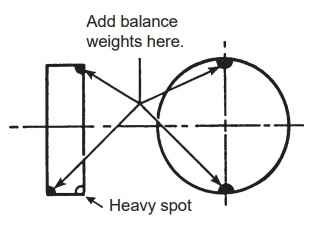
To correct dynamic imbalance, equal weights are placed 180 degrees apart from each other,
one on the inside of the wheel and one on the outside, at the point of imbalance.
An electronic wheel balancer is typically used to find the location(s) and magnitude(s) of both
dynamic and static imbalance on a wheel. There are two main types of wheel balancer: oncar and off-car. With an off-car type, the wheel must be removed from the vehicle and
mounted on the balancer. With an on-car type, however, checks can be performed with the
wheel fitted on the vehicle. A further advantage of the on-car type is that it checks the
balance of all rotating elements (including, for example, the brake disc or drum), not only the
balance of the wheel.
In this module, you are expected to train with an off-car-type wheel balancer. For details of
the balancer, refer to the manufacturer’s operation manual.
General Precautions for Balancer Operation
- Push the wheel securely onto the spindle.
- Do not touch the wheel while it is spinning. If the balancer has a safety cover, it must be fitted. You could otherwise be injured if a weight flew off the wheel.
- Use only weight(s) with the mass(es) indicated by the balancer, and attach it/them only at the indicated position(s).
- When balancer operation is complete, make sure each weight is securely attached.
- It is extremely difficult to assemble a perfectly balanced wheel without using weights owing to variations in rubber thickness around the tire (these are introduced in the moulding process), to variations in metal density around the wheel (these are introduced in the casting process), and to the position of the carcass joint in the tire.
- If a wheel continues to cause vibration after being balanced with an off-car wheel balancer and refitted on the vehicle, try rotating the wheels. If vibration still occures at the same location, then the hub mounting angle, toe-in angle, or camber angle may be incorrect. Alternatively, there may be a fault in the ball joints or bearings of the suspension system.
Post Comment