Electronic 4-wheel Steering Introduction
By steering a vehicle’s rear wheels as well as its front wheels, a four-wheel steering system,
either mechanical or electrical, offers improved handling stability and other benefits. The
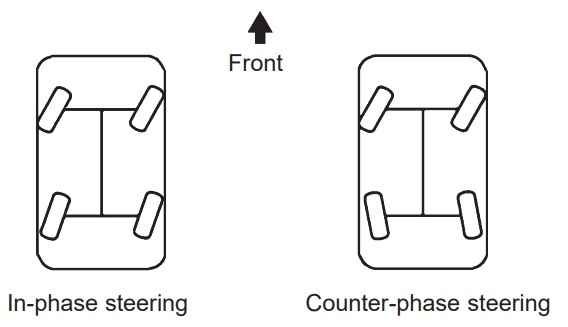
4WS/E-4WS system used by Honda performs two distinct operations: in-phase steering,
whereby the rear wheels are turned in the same direction as the front wheels, and counterphase steering, whereby the rear wheels are turned in the opposite direction. The Honda 4WS/E-4WS system is effective in the following situations:
Lane Changes
During lane-change maneuvers at high speed, the system performs in-phase steering. This
operation enables the vehicle to move in a crab-like manner rather than in a curved path. As
a result, the vehicle is more stable and controllable.
High-speed Straight-line Operation
Even when travelling in a straight line at high speed, a vehicle’s driver frequently needs to
make small steering corrections to maintain his/her desired course. With the Honda
4WS/E-4WS system, in-phase steering of the rear wheels minimizes these corrective
steering inputs.
Side Winds and Other Disturbances
When a vehicle is subjected to side winds, bumpy road surfaces, or other external
disturbances, the driver needs to make steering corrections to maintain his/her desired
course. The Honda 4WS/E-4WS system enables the driver to make these corrective
steering inputs without causing significant changes in the vehicle’s body attitude.
Slippery Road Surfaces
During steering operations on snowy, icy, muddy, and other low-friction surfaces, steering of
the rear wheels suppresses sideways drift of the vehicle’s rear end. As a result, the vehicle’s
direction is easier to control.
Gentle Curves
On gentle curves, in-phase steering of the rear wheels improves the vehicle’s stability.
Parking
During a parking maneuver, a vehicle’s driver typically turns the steering wheel through a
large angle to achieve a small turning radius. By performing counter-phase steering of the
rear wheels, the Honda 4WS/E-4WS system realizes a smaller turning radius than is
possible with a two-wheel steering (2WS) system. As a result, the vehicle is easier to
maneuver into garages and other parking spaces.
Junctions
On a crossroads or other junction where roads intersect at 90 degrees or tighter angles,
counter-phase steering of the rear wheels causes the front and rear wheels to follow
more-or-less the same path. As a result, the vehicle can be turned more tightly as it
negotiates the junction. With a 2WS system, the vehicle would need to follow a relatively
curved path.
Narrow Roads
On narrow roads with tight bends, counter-phase steering of the rear wheels minimizes the
vehicle’s turning radius, thereby reducing side-to-side rotation of the steering wheel and
making the vehicle easier to maneuver.
U-turns
By minimizing the vehicle’s turning radius, counter-phase steering of the rear wheels enables
U-turns to be performed easily on narrow roads.
Electronic 4-wheel Steering Major Components
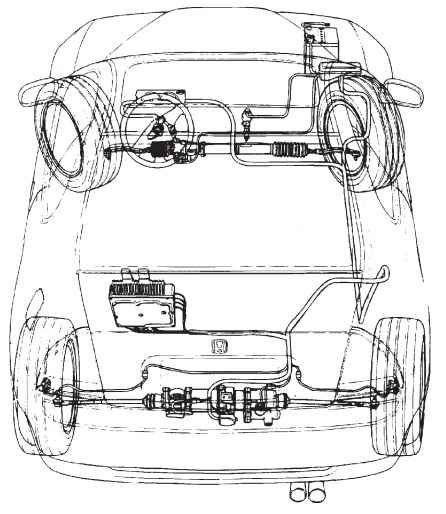
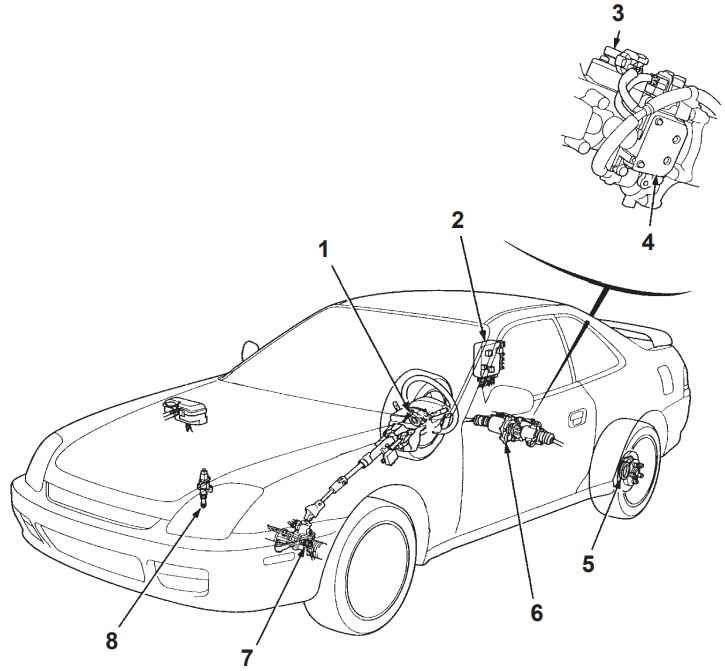
The major components of the E-4WS system are as follows:
- Front main steering angle sensor
- 4WS control unit
- Rear sub steering angle sensor
- Rear main steering angle sensor
- Rear wheel speed sensors (left and right)
- Rear steering actuator
- Front sub steering angle sensor
- Vehicle speed sensor (VSS)
Electronic 4-wheel Steering Basic Function
An E-4WS system uses electronic circuitry to control rear-wheel steering operations. It
determines and achieves the optimum rear-wheel steering phase and angle in accordance
with the vehicle speed, the degree of steering wheel rotation, and the speed of steering
wheel rotation. Simply stated, the system performs counter-phase steering of the
rear-wheels at low speeds and in-phase steering of the rear-wheels at high speeds. As a
result, the system improves stability during lane-change maneuvers at high speed and
minimizes the vehicle’s turning radius at low speeds.
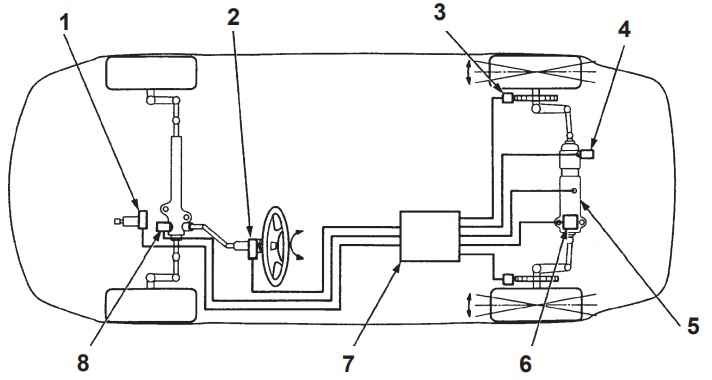
- Vehicle speed sensor
- Front main steering angle sensor
- Rear wheel speed sensor
- Rear sub steering angle sensor
- Rear steering actuator
- Rear main steering angle sensor
- 4WS control unit
- Front sub steering angle sensor
Control Process
The 4WS control unit senses the vehicle speed using signals from the vehicle speed sensor,
and it senses the steering direction, the degree of steering wheel rotation, and the speed of
steering wheel rotation using signals from the front main steering angle sensor and front sub
steering angle sensor. In accordance with these data, the 4WS control unit determines the
optimum rear-wheel steering angle and phase and achieves them by issuing signals to the
rear steering actuator.
During steering operations, the 4WS control unit determines the actual amount and direction
of rear steering actuator movement using signals from the rear main steering angle sensor
and rear sub steering angle sensor. Also, the 4WS control unit checks for discrepancies
between the desired and actual rear-wheel steering angles using signals from the left and
right rear wheel speed sensors (difference between left and right rear wheel speeds). This
feedback arrangement enables highly precise control of rear-wheel steering operations.
Steering of Rear Wheels
The E-4WS control unit alters the rear-wheel steering characteristics in accordance with the
vehicle speed as shown in the following illustration.
Also, the E-4WS control unit alters the rear-wheel steering characteristics in accordance with
the speed of steering wheel rotation as shown in the following illustration.
1 comment