Suspension Function and Components
The suspension is located between the vehicle’s wheels and body. It works in conjunction
with the wheels to absorb vibration and impact forces from the road surface and, in order to
improve driving comfort, reduces the amount of these vibration and impact forces that are
transmitted to the body. It also ensures that the wheels are always firmly in contact with the
road surface and regulates the inclination of the body in order to improve the stability of the
vehicle in any possible driving condition including acceleration, braking, and cornering.
Both of these functions, however, exist in an ambivalent relationship with each other. In
other words, placing the emphasis on either one will generally lead to a reduction in the
effectiveness of the other. Consequently, vibration absorption is balanced against vehicle
stabilization and the suspension’s characteristics are determined to correspond to the
specific type of vehicle involved (i.e., sports car, family-use sedan, etc.)
Although principle components vary slightly for each different type of suspension, a system
will generally consist of arms connected to the body and wheel in order to determine their
positional relationship, springs to absorb impact forces originating at the road surface, and
dampers to control the motion of the springs.
Rigid Axle and Independent Types
Suspension systems can be divided into two major types based on design, namely rigid axle
and independent.
In the former, the left and right wheels are connected with a single axle and the load
directed to the wheels is supported by this. Rigid axle suspension is more effective when it
is desired to maintain a large suspension stroke in vehicles which exhibit large variations in
load as a result of changes in cargo weight or passenger numbers. Consequently, it is
mainly employed in large or mid-sized trucks and busses. The drawback of this type of
suspension is that driving comfort and stability are inferior to those of the independent type.
In the independent type of suspension, there is no axle connecting the left and right wheels;
the load directed to the wheels is supported by the suspension arms. Thus, each wheel can
move independently in response to its specific road condition. Although this type is more
complicated in terms of design than the rigid axle type, unsprung mass is lighter and wheelto-ground contact is better. Accordingly, driving comfort and stability are superior when this
type of suspension is adopted. Sports utility vehicles (SUVs), sports cars, compact trucks,
and other similar vehicles commonly use independent suspension.
Sprung Mass and Unsprung Mass
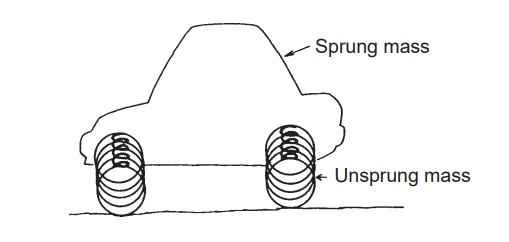
Sprung mass refers to the weight which is supported by the suspension spring; unsprung
mass, to the weight which isn’t. Unsprung mass includes the weight of wheels, rear axle,
steering linkage, and some suspension components. A low unsprung mass has a large
effect in improving driving stability.
Independent Suspension Variations
Independent suspension is divided into swing arm and double arm types.
Swing Arm Type
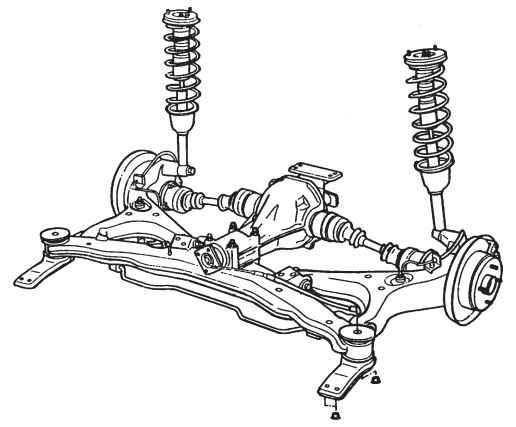
The following are all types of swing arm independent suspension.
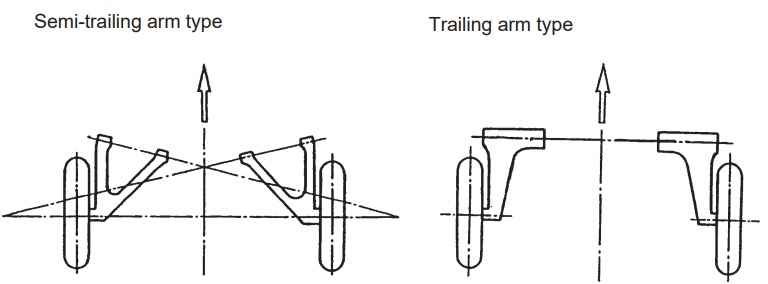
- Trailing arm type
Both trailing arm and semi-trailing arm types exist.
- Parallel link type
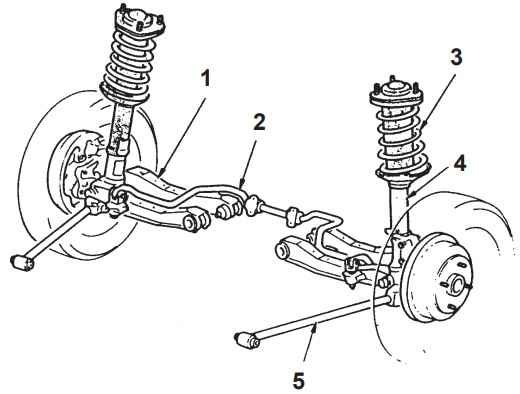
- Suspension arm (parallel link)
- Stabilizer
- Coil spring
- Shock absorber
- Strut bar
Double Link Type
- MacPherson strut type
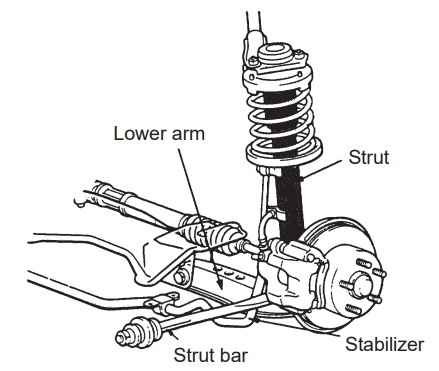
- Wishbone (double wishbone) type
Double Wishbone Suspension
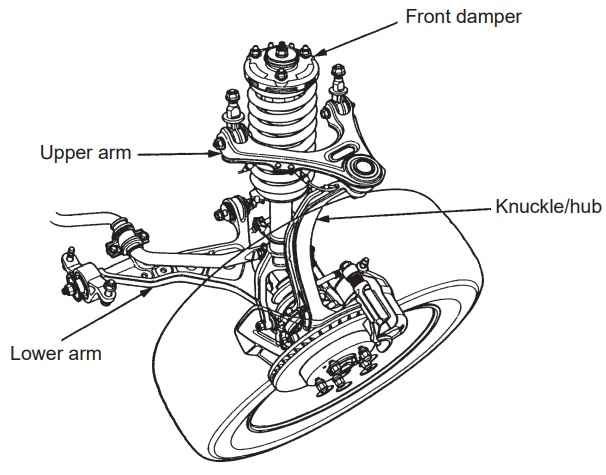
The double wishbone suspension system comprises of an upper arm, lower arm, and a
damper assembly (coil spring and shock absorber) among other components. Each arm is
connected to the knuckle and body using bushes.
When using for the front suspension, the upper arm is positioned in the region of the top of
the wheel in order that the lateral forces experienced during cornering do not cause the
wheel alignment to be disturbed.
When using for the rear suspension, the upper arm is currently positioned inside the radius
of the tire in order to implement a reduction in size. Also, in addition to the upper arm and
lower arm, a trailing arm has been added. Rubber bushes are used at the pivot points of
these arms in order that the trailing arm can move a small amount in the lateral and
transverse directions in response to external forces. This affords a considerable
improvement in driving comfort while, at the same time, ensures that wheel alignment is
maintained in the most suitable condition.
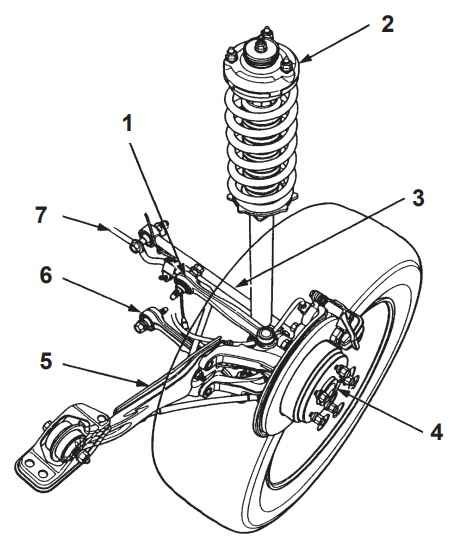
- Upper arm
- Rear damper
- Lower arm B
- Hub bearing unit
- Trailing arm
- Lower arm A
- Stabilizer bar
The features of double wishbone suspension are as follows:
- A large amount of freedom is available when setting geometry; precise settings can be
made for driving comfort, steerability, and other factors. - The suspension arms can support non-vertical external forces, thus reducing damper
friction and ensuring excellent operation. - The vertical size of the suspension can be made more compact.
- There is little deterioration in camber during cornering; consequently, the area of the tireto-ground contact surface is large, ensuring that motion is efficiently transferred.
MacPherson Strut Suspension
The MacPherson strut suspension is essentially simple in design and consists of a lower arm
and damper assembly. The latter contains a shock absorber and a coil spring, often referred
to as a strut.
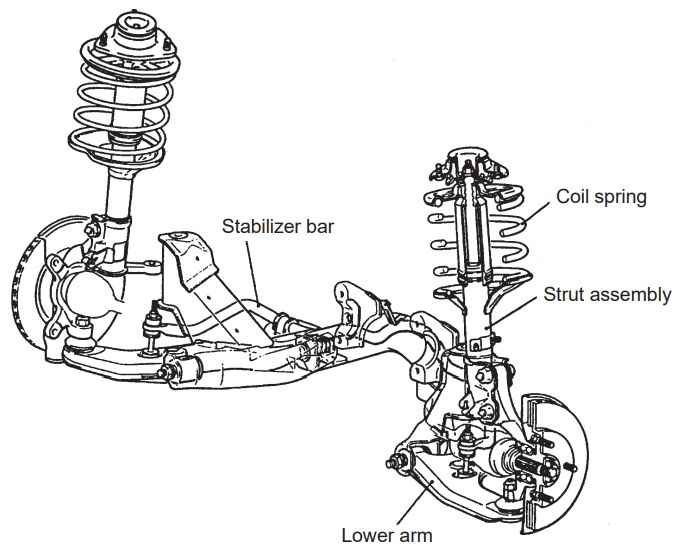
The features of MacPherson strut suspension are as follows:
- There are few parts and the overall assembly is light. Installation is simple and the
assembly is easily maintainable. - Sprung mass is reduced.
- The amount of freedom available when setting geometry is small, and there is a relatively
large amount of camber deterioration. - The vertical size of the assembly is large.
- The damper assembly (or strut) also supports non-vertical external forces, resulting in the
transmission of damper friction.
Post Comment