Spark Plug Introduction
The purpose of the spark plug is to introduce ignition energy to the combustion chamber in the form of an electric arc between two electrodes, thus initiating the combustion of the air/fuel mixture which is present there.
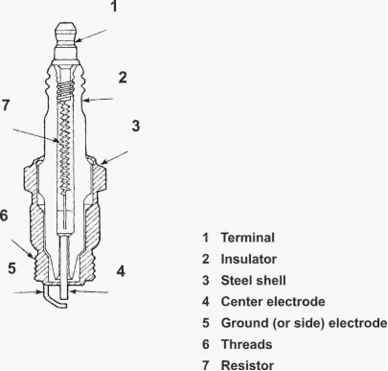
An ignition coil generates a high-voltage current which flows through an ignition wire and the spark plug terminal to the center electrode. This current then crosses the gap between the center electrode and the ground (or side) electrode in the form of an arc, and this arc ignites the air/fuel mixture which is contained in the combustion chamber. Finally, the current flows to ground through the spark plug’s steel shell and through the engine block.
Certain spark plugs feature a resistor between the spark plug terminal and the center
electrode so that the amount of electromagnetic interference (which effects the vehicle’s
Radio, etc.) that is generated by the spark plug can be reduced.
Since spark plugs are corroded by both the discharge of arcs and by the high-pressure, high-temperature combustion gasses which are present in the combustion chamber, it is important that these components be inspected regularly.
Types of Spark Plug
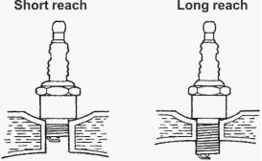
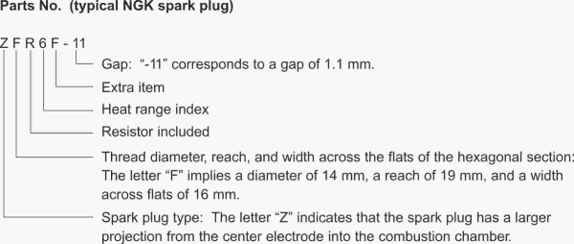
Spark plugs come in but one shape; however, the threaded section which is located below the steel shell for the purpose of assembly to the cylinder head comes in a number of different sizes. This being said, all of the spark plugs which are used in Honda engines are of the 14-mm diameter size. Furthermore, the length of the spark plug from the shell’s seat contact surface to the bottom of the shelli.e., the “reach” of the spark plug also has a number of different variations. This dimension is extremely important, and although it is possible to assemble a spark plug of the incorrect reach to an engine, the electrodes will not be positioned in the required location within the combustion chamber; consequently, a number of different problems including misfires (i.e., failure of the air/fuel mixture to ignite) can result.
Platinum-tipped Spark Plugs
Spark plugs are currently available with a large number of different electrode shapes. It is, however, beyond the scope of this module to discuss each of these. Accordingly, the following will provide a brief description of a spark plug type which is also used at Honda: the platinum-tipped spark plug. As its name suggests, the platinum-tipped spark plug employs a center electrode which ismanufactured from the metal platinum. Thanks to its excellent resistance to corrosion, the use of platinum ensures a long service life for the spark plug. However, because there is a possibility that the center electrode’s platinum sectioncould become detached as a result of cleaning with a wire brush, with a plug cleaner, or with same other similar item, this type of spark plug cannot be re-used after cleaning.
Heat Range
In order that spark-plug characteristics other than the above-mentioned thread diameter and reach may be understood, an index known as the heat range index is used. With respect to this, the following will provide an explanation of two important temperaturerelated keywords: self-cleaning temperature and pre- ignition temperature.
Self-cleaning Temperature
If the temperature of the center electrode is too low, the carbon which is generated as a result of incomplete combustion will adhere to the spark plug’s insulator; consequently, the resistance between the insulator and the shell will drop and current leakage may result. In such a case, the arc generated in the spark plug’s gap will be incomplete and this may lead to the occurrence of misfires. However, when the temperature of the center electrode exceeds a certain temperature, any carbon that has adhered will be burnt off so that the resistance of the insulator will return to its original value. The temperature at which the burning off of carbon commences (i.e., approximately 450 to 870 deg. C) is referred to as the self-cleaning temperature.
Pre-ignition Temperature
In addition to the self-cleaning temperature, there is another temperature of considerable importance for the spark plug, and if the temperature of the center electrode should exceed this higher temperature, the electrode itself will initiate the combustion of the air/fuel mixture before the spark is generated (i.e., pre- ignition will occur). The temperature at which this phenomenon is first noticed is referred to as the pre-ignition temperature, and in addition to the above-mentioned problem, electrode scorching and insulator breakage can result if it is Exceeded.
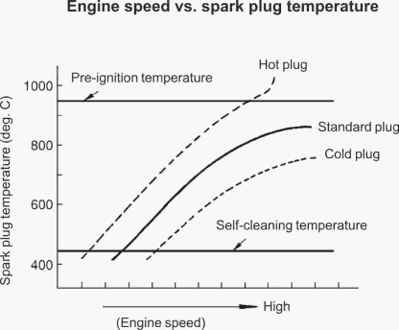
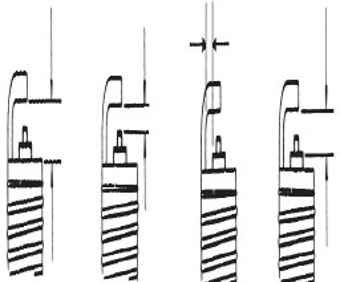
It is important, therefore, that the spark plugs be operated at a temperature which is between the self-cleaning temperature and the pre-ignition temperature. However, the temperature at which a spark plug operates is a factor of its mounting position, of combustion chamber shape, and of engine character- that is, whether the engine in question is a high-speed of a low-speed engine. It is for this reason that spark pluga with different ceramic insulator shapes and metal-shell contact shapes, such as these shown in the diagram, have been made available. The selection of these spark plugs allows adjustment both of the area which is exposed to the combustion chamber’s heat, and of the length of the path along which heat is released to the water jacket, via the cylinder head, thus allowing a wide range of different temperature characteristics to be achieved.
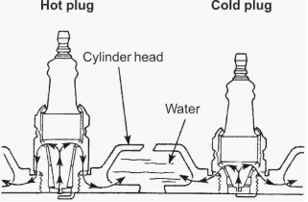
Spark plugs which have high heat-dispersion performance are branded as cold-type spark plugs; those with low performance, as hot-type spark plugs.
The above-mentioned heat range index.can be used to reveal more differences between
these different types. Different manufactures use different methods for determining and
displaying heat range indices and care should be taken accordingly. (For example, certain manufactures use higher values for cold-type spark plugs whereas others use lower values.)
Spark Plug Removal
When removing a spark plug’s ignition wires, the Libber boots should be held and the wires should be pulled out carefully.
Also, before any spark plugs are removed, it is of the utmost importance that an air gun or compressed air is used to remove any dirt or foreign objects from the vicinity of these items. If this is not carried out, the dirt and foreign objects could fall through the plug hole and enter the cylinder when the spark plug is removed – as can be imagined, this could then lead to damage of the pistons or cylinders.
Use a socket wrench and spark plug socket of the correct size when removing a spark plug: use of incorrectly-sized tools could lead to damage of the shell’s hexagonal section or of the insulator.
Also, spark plugs that have been removed should be checked for the presence of gaskets. If a new plug were to be installed without fitting the appropriate gasket, engine pressure leaks or other similar problems could occur.
Spark Plug Inspection
Two distinct procedures are to be performed during spark plug inspection. These are:
- Inspection of the electrode gap using a spark- plug gap gauge
- Visual inspection
Spark Plug Electrode Gap Inspection
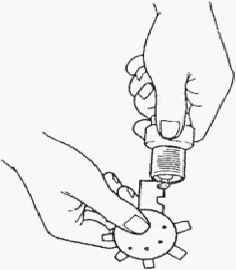
Implementing the same technique as for a feeler gauge, examine the electrode gap using a spark-plug gap gauge. If a gap is too wide, it may result in misfiring; if it is too narrow, it may cause rough idling and lead to prematurely burned electrodes.
Refer to the relevant shop manual for the specified plug gap.
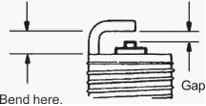
If the gap does not meet the appropriate specifications, adjust it by bending the side electrode using the electrode bender which is provided with the gap gauge. The diagram indicates the point at which the electrode should be bent, and care should be taken not to damage the electrode during this procedure.
NOTE:
The gap of platinum-tipped spark plugs cannot be adjusted; if it is out of specification, the
spark plug must be replaced.
Spark Plug Visual Inspection
Before commencing an inspection, confirm that the spark plug being used is of the type specified in the S/M. In certain cases, spark plugs of a hotter or colder range may better suit the operating condition of the engine in question, and this should be determined based on examination of the spark plug itself.
- If the plug is sooty (i.e., the insulator, the electrodes, and/or the shell are covered with a thick, grayish-black deposit which is both powdery and velvety in nature):
Hotter plugs should be used. - If the electrodes have melted, the insulator is porous, or the insulator is pale gray:
Colder plugs should be used.
Following this, perform a visual inspection of all items which are indicated in the shop manual.
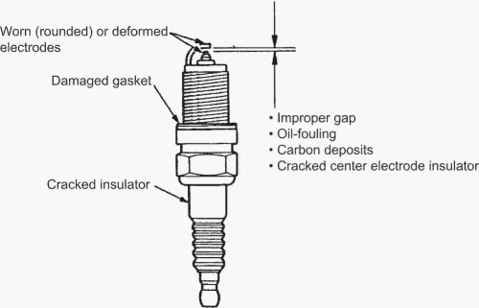
NOTE:
If any spark-plug problems are identified during the inspection, inform the service manager and request further instructions. Many such problems are not the direct result of the spark plugs themselves being faulty, but rather are caused as a result of some other engine. problem or problems, and as such, certain spark plug abnormalities could indicate that a higher level of engine maintenance is required.
Cleaning
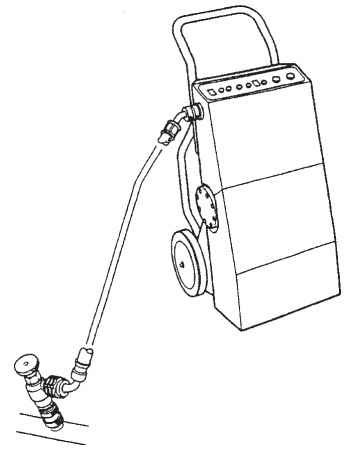
Any spark plugs which are sooty or oily should be cleaned before re-installation. A spark plug cleaner should be used for this purpose.
NOTE:
- Safety goggles must be worn at all times when using a spark plug cleaner.
- Cleaning of platinum-tipped spark plugs could result in damage to the platinum tip and should not be attempted.
Spark Plug Installation
The following precautions should be taken during installationt:
- When spark plugs are being replaced, Honda recommends the use of the type of spark plug which is specified in the shop manual of the vehicle in question.
- Confirm whether or not the old gasket is. still inside the spark plug hole. If a new gasket is installed on top of an old one, combustion pressure leakages may result.
- Before installing a spark plug, apply a small amount of anti-seize compound to its
threaded area. - Screw in the spark plug until it has been inserted fully and check also that the screw threads are mating correctly. Since the cylinder head is made of aluminum, it will be possible to insert a spark plug with incorrectly mating threads if a considerable amount of force is applied. Naturally, this practice. is to be avoided as it could lead to permanent damage of the plug hole threads.
- Always tighten spark plugs to the rated torque these torques have been determined to ensure that gaskets provide a tight seal and prevent the leakage of engine pressure. Also, remember that incorrect. tightening.can lead to overheating or to insulator damage.
2 comments