Car Body Introduction
Currently, most Honda vehicle bodies are the unit construction. Before this technology
became popular, frame constructions were widely used. On frame construction, major
components such as the engine, transmission, and suspension were mounted onto the bare
bones of the vehicle – the frame. Following this, the body (essentially the skin of the
vehicle) was mounted on top. This type of construction is actually still used today for trucks
and some off-road vehicles. The unit construction vehicles, on the other hand, do not have
a special frame. They are composed of body panels which have been designed to provide
the required body strength without the use of a frame.
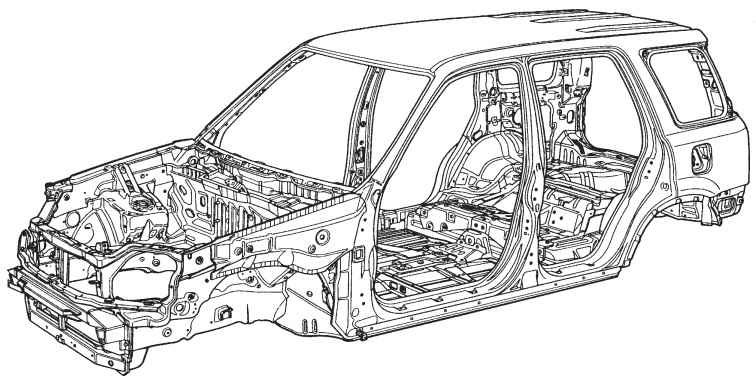
Unit Construction
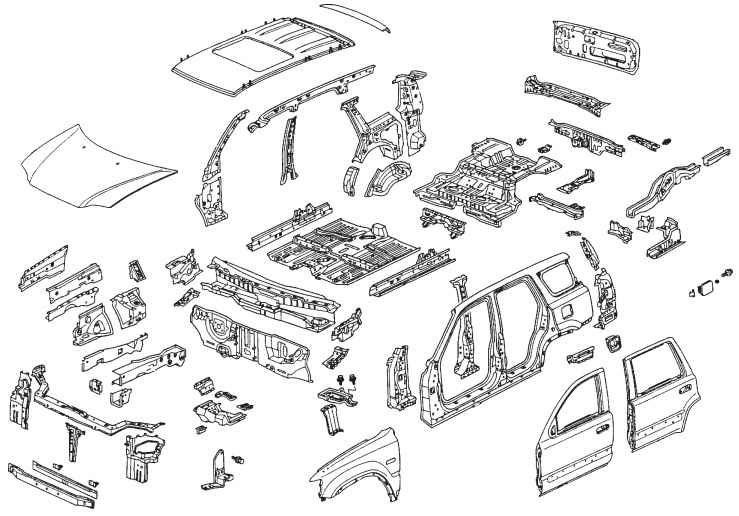
Thin, press-formed steel panels of about 1 or 2 mm in thickness are used in vehicles with
unit constructions. Spot welding is used at locations where these panels overlap and a boxtype structure is created. Certain parts of this basic structure (such as the locations where
the engine or suspension are to be mounted) are required to have extra strength and rigidity.
The addition of ribs, recesses, and other similar indentations to the steel panels is one
common method used to improve strength characteristics. Further increases can be
achieved by welding stiffening material to the relevant areas or by the addition of smaller,
individual sub-frames.
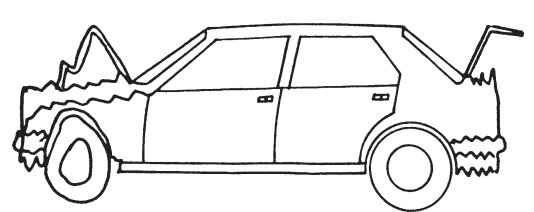
From the point of view of safety, the first benefit of unit constructions is that they provide
increased ability to absorb impact forces. This is achieved by efficiently distributing forces
acting on the body and not allowing them to concentrate in one area. In addition, part of the
body has been designed to be crushable in order to improve the ability to absorb impact
forces even further. Energy from a collision is absorbed as this section is crushed, and
therefore, the amount of energy which is directed to the driver or passengers is reduced.
You may wonder why it would not be better to design and construct a body which would not
be deformed or crushed in any collision. A simple experiment will prove why this is not so.
Fix an egg in a small metal box, strike the box to simulate a collision, and observe what
happens. A hard box would directly transmit the impact force to the egg.
On the other hand, it would also be pointless to design a body which would be completely
crushed in a collision. A survival space for the driver and passengers must be provided.
Various different methods such as reinforcing the floor of the cabin, installing door beams,
and strengthening pillars have been implemented for this purpose.
Based on the above description, Honda vehicle’s bodies are complicated constructions that
have been designed with a number of different objectives in mind. Consequently, a much
higher level of expertise will be required when repairing these bodies than would be required
when repairing frame-type bodies.
Post Comment