Refrigerant Recovery & Recycling Overview
Before performing any work on the components of the air conditioner, it is imperative that the
corresponding system be discharged of refrigerant. And when this operation is being carried
out, it is recommended that a recovery/recycling station be employed so the refrigerant may
be reused instead of being released into the air.
Why Refrigerant Recovery and Recycling are Important
The release of refrigerant from automotive air-conditioner systems has been proven to be
harmful to the environment. All such refrigerants — and particularly the conventionally-used
type, R-12 — contain chemical compounds known as chlorofluorocarbons or CFCs. The
earth is surrounded by a layer known as the ozone layer which acts as a shield, protecting
us from harmful ultraviolet rays, and unfortunately, this layer is damaged when it comes into
contact with CFCs. If increased amounts of ultraviolet rays pass through the holes that
CFCs create in the ozone layer and reach the earth’s surface, it will eventually lead to
irreparable harm to nearly every living thing on this planet. Specifically, ultraviolet rays
cause increased occurrences of skin cancers and eye cataracts; furthermore, these rays can
also damage human immune systems and lead to reduced food-crop yields. And in addition
to this dangerous damaging effect, CFCs also create a greenhouse effect by trapping
excess heat within the earth’s atmosphere.
The production of R-12 has, therefore, been banned, and an alternative substance, R-134a,
is now being used in automotive air-conditioner systems. Although R-134a is less harmful to
the environment than R-12, it is recommended that this refrigerant be collected and reused
as often as possible. In certain countries, R-134a is subject to the same strict regulations
and laws as R-12.
The recovery and recycling of refrigerant has the added advantage of reducing repair costs.
If a recovery/recycling station is available, it should definitely be used to prevent refrigerant
being wasted by releasing it into the atmosphere.
Identifying R-134a Systems and R-12 Systems
Since most vehicles manufactured from 1993 onwards feature air-conditioner systems
utilizing the new R-134a refrigerant, the remaining numbers of the old R-12 systems are
becoming fewer and fewer. Note, however, that R-12 and R-134a are not compatible and
that equipment for air-conditioner system is designated for use with one of these refrigerants
only. Before any work on an air-conditioner is started, therefore, it is important to identify the
type of system fitted in the vehicle.
R-134a components can be identified using the sticker located on the compressor and on
the receiver/dryer, and also by the special imprints found on the system’s hoses. The
components in new systems come with specially-marked protective plastic caps or plugs.
Unlike most of the other components, the O-rings for both types of system are virtually
identical in appearance although a different material is used for each. Care should be taken
to ensure that these components are never mixed or confused with each other. It is
particularly important to keep the two different types of O-rings separated while working on
an air-conditioner system.
Recovery/Recycling Station
A typical recovery/recycling station uses a compressor to draw refrigerant into the station
through an oil separator and uses a liquid pump to circulate the liquid refrigerant through a
filter/dryer, thus allowing moisture to be removed. This type of station also contains a
storage tank that holds the refrigerant for reuse.
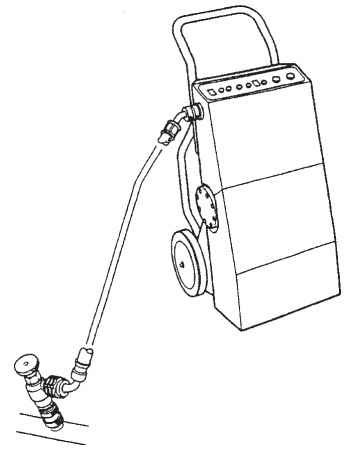
NOTE:
Several types of air-conditioner service sets are available for use. Most of these are “all-inone” type recovery/recycling stations (or service centers); however, portable charging
stations may also be used. Carefully read to the manuals for the available equipment and
follow your instructor’s guidance.
Recovering Refrigerant
When discharging an air-conditioner system, check first of all whether there is any pressure
remaining in the system. If the system is not pressurized, there will be no refrigerant in the
system to recover.
If it has been confirmed that there is pressure in the system, recovery should be carried out
using a recovery/recycling station. Be sure to follow the manufacturer’s instructions when
engaging in this operation.
After the system or systems have been discharged, ensure that the appropriate action is
taken to ensure that moisture cannot enter. If excessive moisture were to enter the system,
the receiver/dryer would become saturated and would have to be replaced.
The recovery/recycling station will also remove a certain amount of oil from the system
during refrigerant recovery, and this oil will be stored within the unit’s oil separator. Measure
the corresponding volume to ascertain the amount of old oil lost during the recovery process
so that the same amount of new oil can be added when the system is subsequently charged.
Furthermore, only new poly-alkylene-glycol (PAG) oil of the brand specified in shop manual should be
used when charging an R-134a system. Oil may be added directly into the discharge side of
the compressor if the system is to be opened for service. Alternatively, if the system is not
opened, an oil injector may be used. In the latter case, be sure to follow the instructions
provided by the oil injector’s manufacturer.
Recycling the Refrigerant
The term “recycling” as used in this module means to purify the refrigerant by removing
moisture and rendering it ready for storage or for refilling. A recovery/recycling station
should be used to recycle the refrigerant, and the station manufacturer’s instructions should
be strictly observed.
After discharging has been completed, the refrigerant tank should be labeled “Recycled
refrigerant” and removed from the station. Use only the approved refillable storage
containers as made by manufacturers of recovery/recycling equipment.
Safety Information
The recovery of refrigerant can be carried out safely provided that the following cautionary
measures are observed:
- Keep away from open flames. Although non-inflammable, refrigerant will produce a
poisonous gas if burned. - Always wear eye protection.
- Work in a well ventilated area. Refrigerant evaporates quickly and can force all the air out
of a small, enclosed area. - Do not inhale either refrigerant or its vapor.
- Never use compressed air to perform a pressure test on R-134a service equipment or on
vehicle air-conditioner systems.
Post Comment