Forward Collision Warning System Introduction
Welcome to article, Forward Collision Warning System.
The Forward Collision System is a camera-based system that detects potential collisions with vehicles in the path of travel.
The Forward Collision Warning system uses the camera images to observe the vehicle’s travel lane.
If it identifies vehicles slowing down or at a stop in the travel lane, the system issues an audible warning, a visual warning in the instrument panel, and flashes a heads up warning on the
windshield.
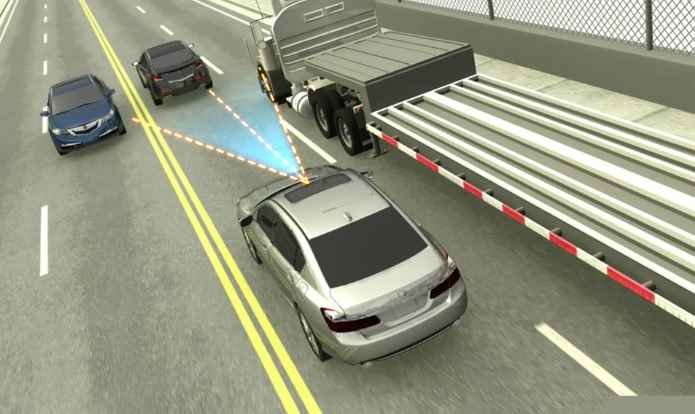
In this article, you will learn about the Forward Collision Warning System, including the system components, system operation, and service considerations.
At the end of this article, you will take a test to evaluate what you’ve learned.
Front Camera Module
This system includes the following components:
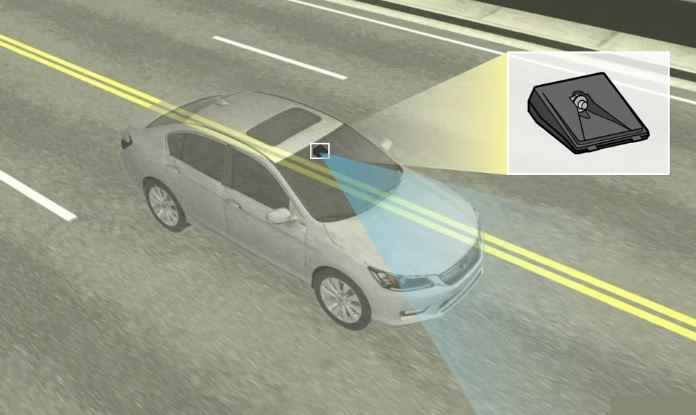
Front Camera Module.
The FCM mounts behind the rear view mirror on the windshield.
Heads-Up Warning Unit
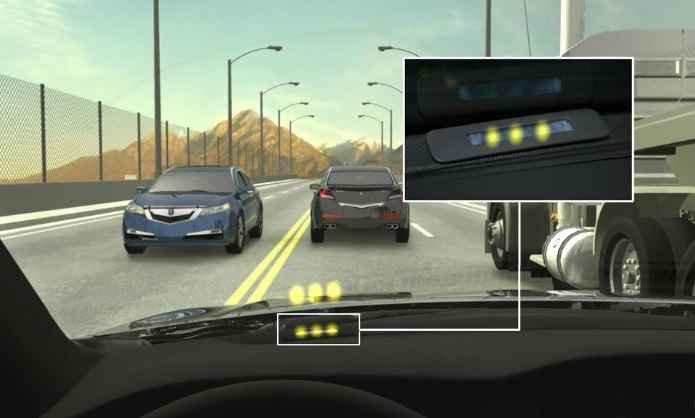
Heads-Up Warning Unit.
The Heads Up Warning module mounts on top of the dashboard in front of the driver, and flashes a light onto the windshield.
Gauge Control Module
Gauge Control Module Warning Indicators.
The Gauge Control Module Warning Indicators include a speaker, warning indicator lamp and MID messages.
The second generation FCW warnings operate similarly but differ in appearance.
System Diagram
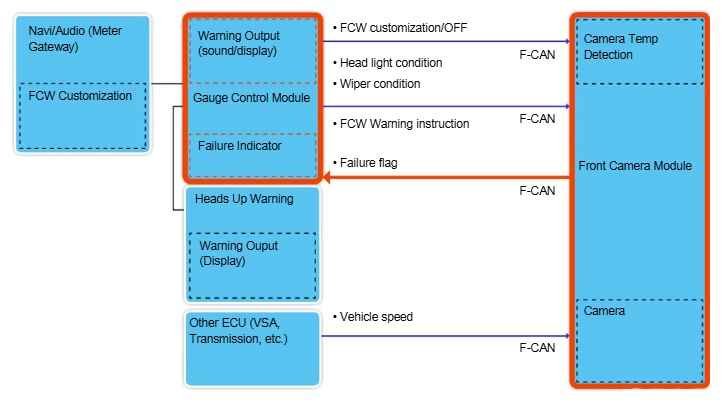
To control the Forward Collision Warning System, the Front Camera Module, or FCM, receives information from the integrated camera, VSA Control Module and the PCM, and sends commands to the Gauge Control Module to issue warnings to the driver.
Forward Collision Operation-Normal 1 of 3
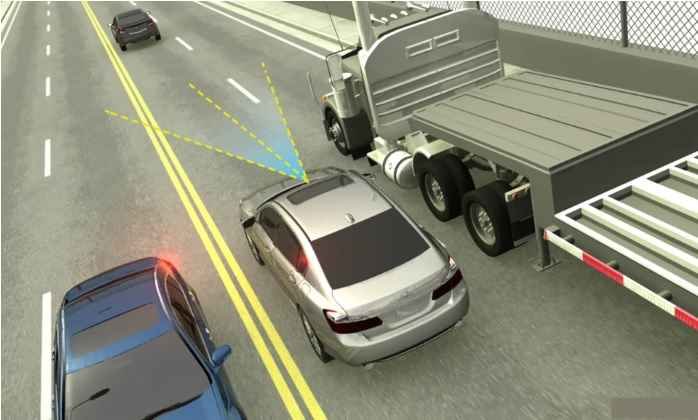
The FCM uses the camera images to observe the vehicle’s travel lane, and the system becomes active at speeds above 15 km/h (9 mph).
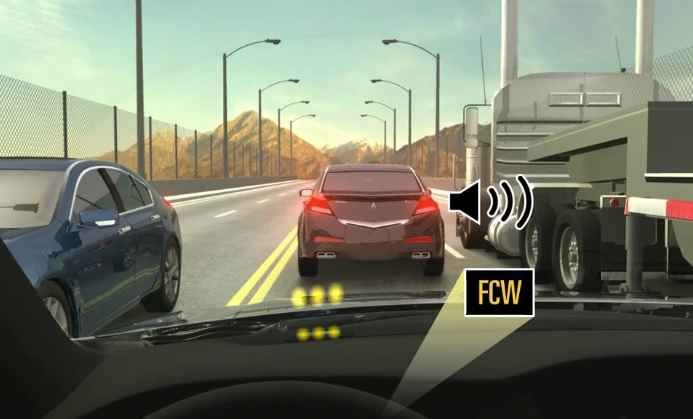
If it identifies vehicles or objects slowing down or at a stop in the travel lane, the system issues an audible warning, a visual warning in the instrument panel, and a heads up warning on the windshield.
To determine when warnings are displayed, the FCM calculates the Time to Collision based on vehicle speed and distance between the vehicle and object in the path.
FCW warnings are issued at different times before a collision could occur depending on following distance selected in the customization menu.
Operation-Normal 2 of 3
FCW warnings stop when the lane clears in front of the vehicle.
The lane is considered clear when the calculated time to collision becomes greater than the thresholds.
Operation-Normal 3 of 3
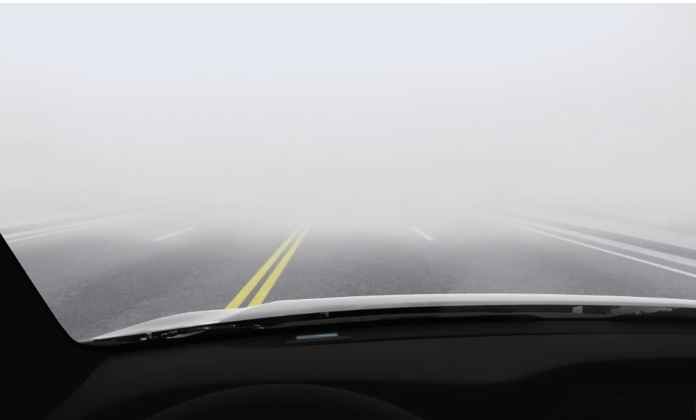
The system may not issue frontal collision warnings if environmental conditions prevent the camera from clearly identifying objects for example in heavy rain or foggy conditions.
Camera Blocked
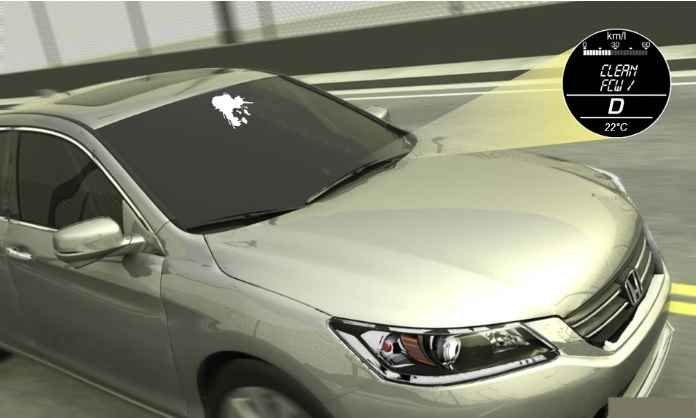
When the camera view becomes blocked for longer than 5 minutes,
A warning message is issued instructing the driver to clean the windshield.
Camera Too Hot
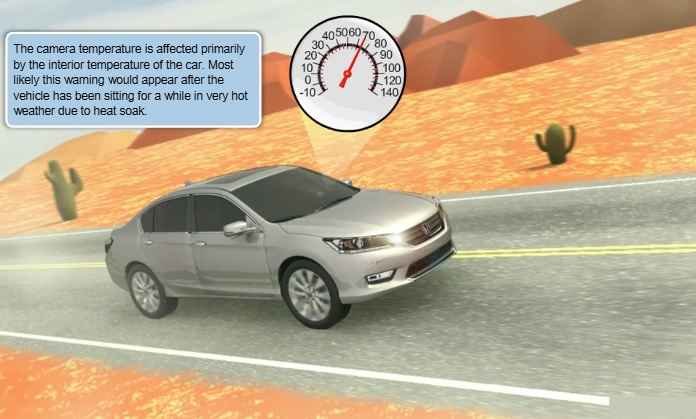
If the FCM detects that the camera temperature is too hot, A warning message is issued that the system will not work.
The system will resume operation when the camera temperature is within operating specifications.
Forward Collision Warning System Control
The FCM contains all Frontal Collision Warning logic within the module.
Vehicle speed information is received from the PCM.
Headlight and wiper information is received from the Gauge Control Module.
After the FCM processes this information, it then sends signals to the Gauge Control Module to turn on or off warnings.
Failure Notification
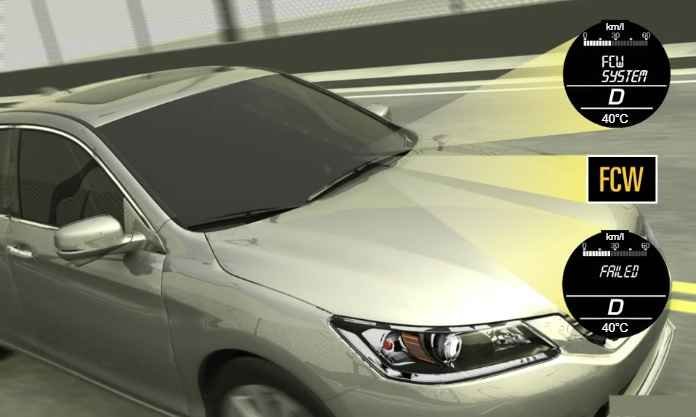
The FCM contains internal self diagnostics.
When a failure is detected, the system turns on a warning indicator lamp and a message in the MID.
The system DTCs can be accessed using the Scanner.
Customization
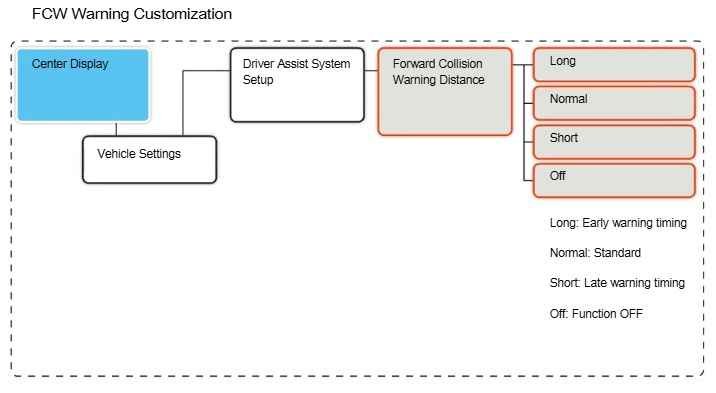
Following distances can be customized, or the system can be turned off through the i-MID.
Possible selections include Long Following Distance, Normal Following Distance, Short Following Distance, or OFF.
These settings are used by the FCM to control the timing of collision alerts.
Camera Aiming Part 1
Proper alignment of the Front Camera module is critical for the proper operation of the Forward Collision Warning system.
The camera needs to be aimed any time the windshield or the Front Camera Module is replaced Or after the vehicle has had significant collision repairs.
Two different aiming methods can be used:
One is Target Alignment Calibration, The other is Service Point Calibration.
Camera Aiming Part 2
System Malfunctions
The Forward Collision Warning system sets DTCs when system failures occur.
Some DTCs will cause the FCW warning indicator lamp to turn on with a MID message, and some will not.
In addition, VSA system failures will cause the FCW system to become inoperative.
In these cases, troubleshoot the VSA system before troubleshooting the FCW system.
Post Comment